

By ProCannabis Editorial Team — Updated May 2026
The Basics:
- Raw THCA doesn't get you high. Heated THCA does — because heat converts it into Delta-9 THC, which is the actual intoxicating compound.
- If you eat THCA gummies, your body uses stomach acid and liver enzymes to convert some of the THCA into Delta-9 THC. Most THCA gummies produce a real high — they just take longer to feel than regular Delta-9 gummies.
- Smoking or vaping THCA flower converts almost all of it to Delta-9 THC at the moment of combustion. That high is essentially identical to traditional cannabis.
- The "THCA is non-psychoactive" claim is technically true for raw, uneaten THCA. It misleads when applied to products you actually consume.
- Whether THCA gummies will affect you, and how much, depends on the dose, your tolerance, and how completely the THCA converts to Delta-9 during digestion.
"Does THCA get you high?" is one of the most-Googled questions in hemp, and the answers floating around online are almost uniformly bad. Half the articles say no. Half say yes. Most don't explain why both answers are technically correct depending on what you're asking. This post is the version that actually answers the question.
Here's the short version: THCA in its raw form doesn't get you high. THCA after it's been processed — including through the chemistry of digestion or the heat of combustion — converts into Delta-9 THC, which absolutely gets you high. The product on your shelf is the raw form. The compound that ends up in your bloodstream after you consume it is mostly the converted form. Both statements coexist.
What THCA Actually Is
THCA stands for tetrahydrocannabinolic acid. It's the precursor compound that exists naturally in living cannabis and hemp plants. As long as the plant material stays raw and cool, THCA stays as THCA.
Chemically, THCA has an extra carboxylic acid group attached to its molecular structure (the "A" in the name). That extra group is what prevents it from binding meaningfully to your CB1 receptors — the receptors in your brain responsible for the psychoactive effects of cannabis. Without efficient CB1 binding, no high.
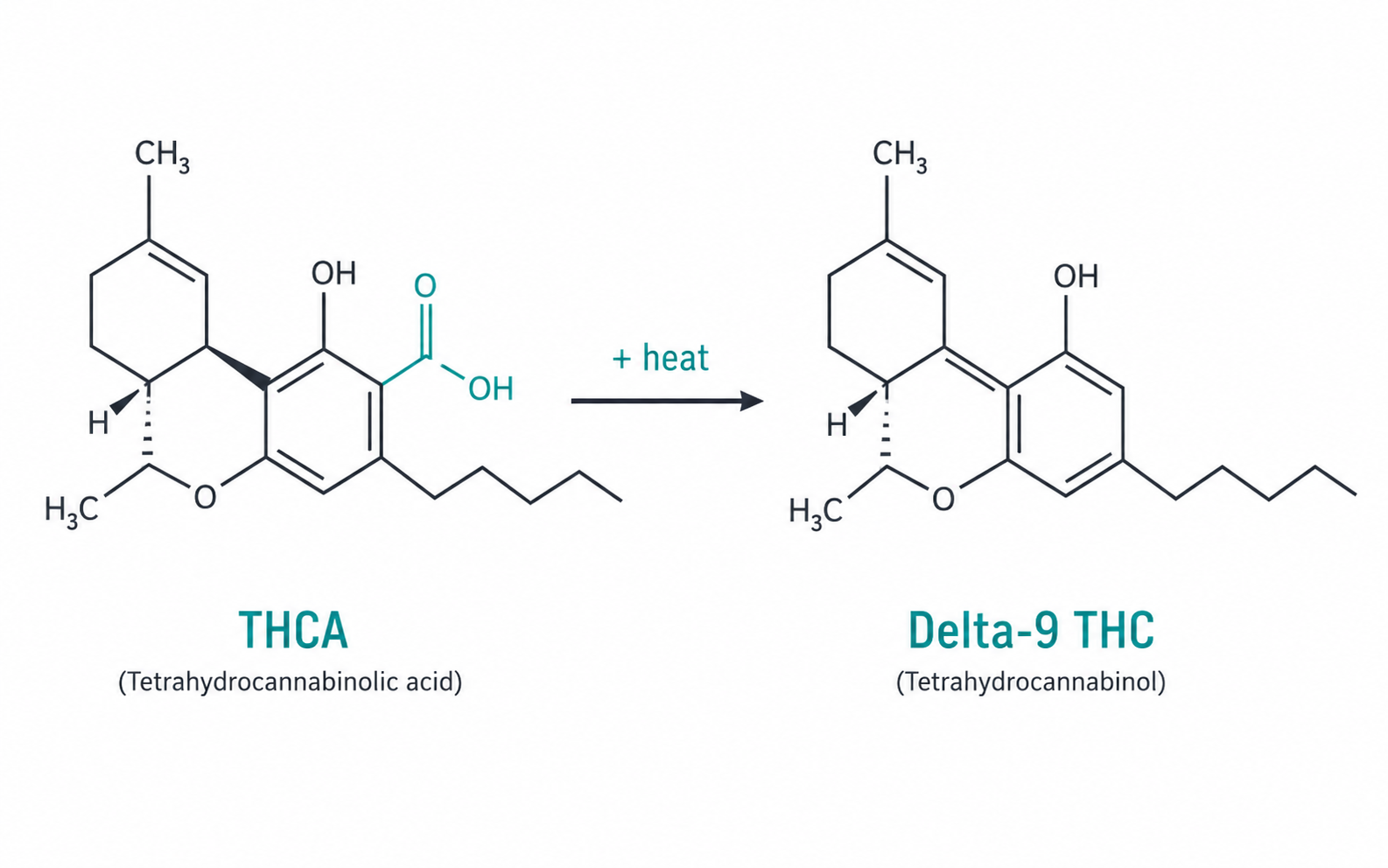
Apply heat — combustion, vaping temperatures, oven baking, or sometimes just enough warmth and time — and THCA undergoes a chemical process called decarboxylation. The carboxylic acid group falls off as carbon dioxide. What's left is Delta-9 THC, the molecule we associate with cannabis intoxication. Research published in the National Center for Biotechnology Information confirms this conversion happens at temperatures as low as 110°C (230°F), with maximum conversion around 122°C.
So the same plant material can be non-intoxicating one minute and fully intoxicating the next, depending on whether it's been heated.
The Legal Loophole This Creates
The 2018 Farm Bill defines hemp as cannabis containing less than 0.3% Delta-9 THC by dry weight. It measures Delta-9 only — not THCA, not Delta-8, not the total intoxicating potential after heating. Read the actual text of the 2018 Farm Bill if you want the legal source.
That measurement window matters. Because THCA hasn't decarboxylated yet, it doesn't count toward the Delta-9 limit. A hemp flower can contain 25% THCA and still test under 0.3% Delta-9 — making it federally legal to sell. The moment that flower gets lit on fire or vaporized, the THCA converts to Delta-9 and you're consuming what is functionally marijuana.
This is why THCA products are everywhere now. The Farm Bill technicality made them legal at the federal level, and the supply chain followed. Most "hemp" flower, vapes, and gummies sold online contain THCA as the primary cannabinoid.
So What Happens When You Eat a THCA Gummy?
This is where the question gets interesting and where most online content fails. A THCA gummy contains raw THCA, not Delta-9 THC. If you measured the gummy in a lab before eating it, you'd find mostly THCA. After you eat it, the conversion happens through two mechanisms working together. Your stomach acid drives acid-catalyzed hydrolysis — the carboxylic acid group that prevents THCA from binding to your CB1 receptors gets stripped off in the acidic environment of your stomach. Then your liver finishes the job during first-pass metabolism, where CYP450 enzymes (the same enzyme family that processes many prescription medications) convert the remaining THCA. Body temperature isn't hot enough to cause real decarboxylation on its own — that requires temperatures around 110°C — so the conversion is chemical and enzymatic, not thermal.
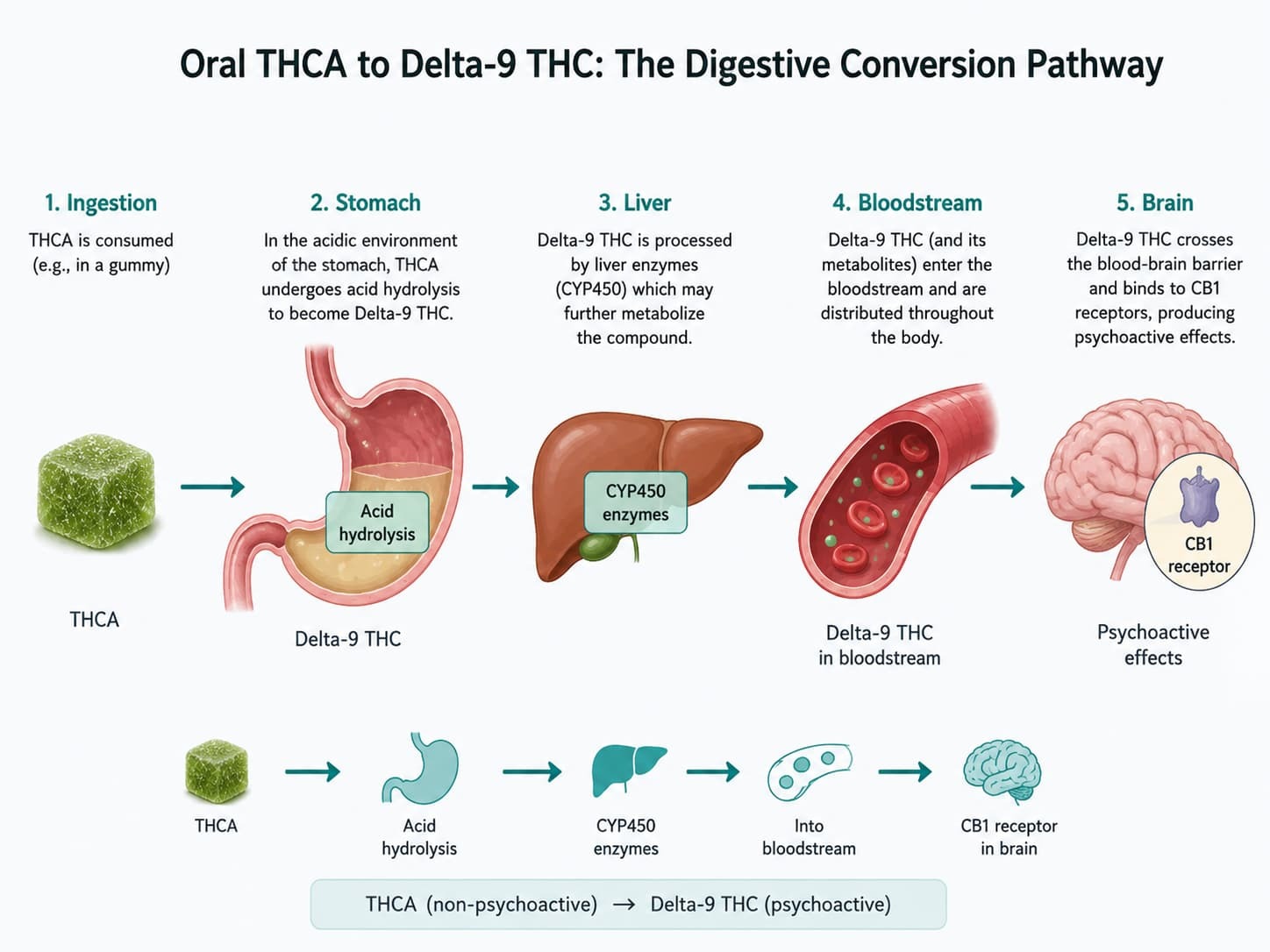
Conversion efficiency in the body produces variable results — pharmacology research suggests somewhere between 20% and 50% of ingested THCA converts to active Delta-9 during digestion and first-pass metabolism. The exact percentage depends on your individual metabolism, what else you ate, how long the gummy sat in your stomach, and the gummy's formulation.
Some THCA gummy manufacturers pre-decarboxylate during production by gently heating the formulation, which increases the conversion ratio in your body. Others don't, leaving the conversion entirely to your digestion.
The practical result: a 25 mg THCA gummy doesn't deliver 25 mg of Delta-9 THC to your bloodstream. It delivers something like 10-15 mg, depending on the factors above. That's still a real dose. Plenty to feel high. Just less than the milligram count on the label might suggest.
What This High Actually Feels Like
Once the converted Delta-9 reaches your bloodstream, the experience is essentially indistinguishable from any other Delta-9 edible. Your body doesn't know whether the Delta-9 in your bloodstream came from a marijuana gummy, a hemp Delta-9 gummy, or a converted THCA gummy. The molecule is the same.
What does differ from the user's perspective:
- Onset time runs longer. Most edibles kick in around 30-90 minutes. THCA gummies often run on the longer end of that range — sometimes up to 2 hours — because conversion takes time in addition to standard digestive absorption.
- The buildup feels more gradual. Because conversion is happening continuously as the gummy works through your system, the dose effectively arrives in waves rather than all at once. Many users describe it as a smoother climb compared to a regular Delta-9 edible.
- Peak intensity can be lower for the same labeled dose. Since not all the THCA converts, the practical "ceiling" of a THCA gummy is usually below a Delta-9 gummy of equivalent milligrams.
- Duration is similar. Once the Delta-9 is in your system, it metabolizes on its own normal timeline — 4 to 8 hours depending on dose and individual factors.
Anyone telling you THCA gummies don't get you high either hasn't tried one or is selling something with marketing language that downplays the actual effect.
What About Smoking or Vaping THCA?
This is where the "THCA isn't intoxicating" line falls apart completely. When you light THCA flower or vape a THCA concentrate, the heat does the decarboxylation instantly. Almost all the THCA converts to Delta-9 THC at the moment of inhalation, and it enters your bloodstream through your lungs within seconds.
The high from smoked or vaped THCA is essentially identical to traditional cannabis — same onset speed, same peak intensity, same duration. The starting material was federally legal hemp. The compound entering your bloodstream is the same Delta-9 THC found in marijuana. Your body and your brain can't tell the difference.
If anyone tells you THCA flower or THCA vapes are "non-psychoactive," they're either uninformed or being deliberately misleading.
So When Is "THCA Doesn't Get You High" True?
The statement is accurate in exactly one scenario: when THCA stays raw and unheated. That includes:
- Eating raw cannabis flower — for example, blending it into a juice or smoothie. Raw plant material contains THCA in its undecarboxylated form, and consuming it raw doesn't get you high. Some people do this for its claimed anti-inflammatory or neuroprotective effects.
- Topical THCA products — creams, balms, and salves applied to the skin. Topicals don't enter your bloodstream meaningfully and don't cross the blood-brain barrier, so no psychoactive effect regardless of whether the THCA converts.
- Pure isolated THCA products used in cold preparations — research compounds and certain wellness tinctures kept entirely raw.
Outside those scenarios, THCA's "non-psychoactive" status is a chemistry technicality, not a practical reality.
What Affects How Much You Feel
Three variables determine the actual intensity of your THCA gummy experience:
- Conversion efficiency. How completely the THCA in your gummy converts to active Delta-9 in your body. Affected by the gummy's manufacturing process (whether it's pre-decarboxylated), your individual metabolism, and what else is in your stomach.
- Your tolerance. Regular cannabis users feel less from the same dose than first-timers. THCA doesn't bypass tolerance — once it converts to Delta-9, your tolerance responds normally.
- The dose itself. A 25 mg THCA gummy and a 10 mg Delta-9 gummy may produce roughly similar effects after conversion. Always start low and wait at least 90 minutes before considering more.
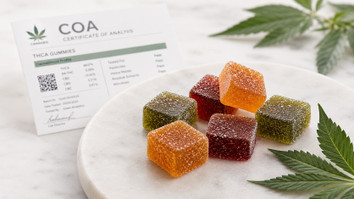
The COA (Certificate of Analysis) on a quality THCA gummy will list the total THCA content. To estimate the effective Delta-9 equivalent, multiply by roughly 0.3 to 0.5 (a reasonable midpoint of typical conversion rates). A 50 mg THCA gummy probably delivers somewhere between 15 and 25 mg of effective Delta-9 in your bloodstream.
Read more: How hemp-derived Delta-9 vapes compare to THCA products
Will THCA Gummies Show Up on a Drug Test?
Yes, and this is one of the most important things THCA marketing tends to obscure. Standard drug tests look for THC-COOH, the metabolite your body produces when it processes Delta-9 THC. Since THCA converts to Delta-9 in your system, your body produces the same metabolites it would from a regular cannabis edible.
The "hemp-derived" label changes the legal status of the product. It does not change the lab result. If you're subject to drug testing, THCA gummies are not the workaround some marketing implies. Plan accordingly.
Frequently Asked Questions
Does THCA get you high? +
Yes, when consumed — though indirectly. Raw THCA doesn't bind to your CB1 receptors, but heat (during smoking or vaping) and your body's digestive chemistry (during ingestion) convert it into Delta-9 THC, which does. THCA gummies, flower, and vapes all produce a real high once consumed.
How long do THCA gummies take to kick in? +
30 to 120 minutes for most users, typically on the longer end. THCA gummies need extra time because the THCA has to convert to Delta-9 through stomach acid and liver metabolism before you feel effects. Wait at least 90 minutes before considering more.
Is the high from THCA different from regular Delta-9? +
Once it converts, no. The Delta-9 in your bloodstream is the same molecule whether it came from THCA, hemp Delta-9, or marijuana. The conversion process makes onset slower and the buildup more gradual, but the peak effect feels essentially the same as any Delta-9 edible.
Why do some sources say THCA isn't psychoactive? +
Because raw THCA isn't — it's the chemistry technicality. Sources that stop there mislead readers who are going to actually consume the product. Once heat or your body's digestive chemistry converts THCA to Delta-9, the result is fully intoxicating.
How strong is a 25 mg THCA gummy compared to a 25 mg Delta-9 gummy? +
Weaker, typically. THCA conversion in the body isn't 100% efficient, so a 25 mg THCA gummy usually delivers somewhere between 8 and 15 mg of effective Delta-9 to your bloodstream. Same labeled dose, different real-world intensity.
Are THCA gummies legal? +
Federally, yes — under the 2018 Farm Bill, as long as the product contains less than 0.3% Delta-9 THC by dry weight. State law varies significantly, with some states (like Arizona) classifying THCA as a controlled substance regardless of federal legality. Check your specific state's rules before buying.
Will a THCA gummy fail a drug test? +
Yes. Once THCA converts to Delta-9 in your body, you produce the same THC-COOH metabolite tested for in standard drug screens. The legal status of the product doesn't change the lab result.
How do I know how much THCA is in a gummy? +
Check the COA (Certificate of Analysis). Every legitimate brand publishes one — usually accessible via a QR code on the label or on the product page. The COA lists the actual THCA content per gummy. Brands that don't publish a COA aren't worth buying.
What It Comes Down To
"Does THCA cause a high" has a more honest answer than most THCA marketing suggests. The compound itself doesn't bind to your CB1 receptors in raw form. But "raw form" only describes the product on the shelf. The moment you consume it — whether through smoking, vaping, or digestion — heat or your body's chemistry converts the THCA into Delta-9 THC, the molecule that absolutely gets you high.
For practical purposes: if you're buying THCA gummies, flower, or vapes, plan as if you're consuming Delta-9. Start with a lower dose than you'd take of a labeled Delta-9 product, give it more time to kick in, and don't expect a smoke or vape session to feel materially different from traditional cannabis.
You can browse lab-tested THCA gummies on ProCannabis — every product page includes the full COA so you can verify exactly what's in the gummy before you buy.