

By ProCannabis Editorial Team — Updated June 2026
The Basics:
- CBD and CBN are both non-intoxicating cannabinoids derived from hemp, but they're sourced and produced differently — CBD comes directly from the cannabis plant, while CBN forms over time as THC degrades.
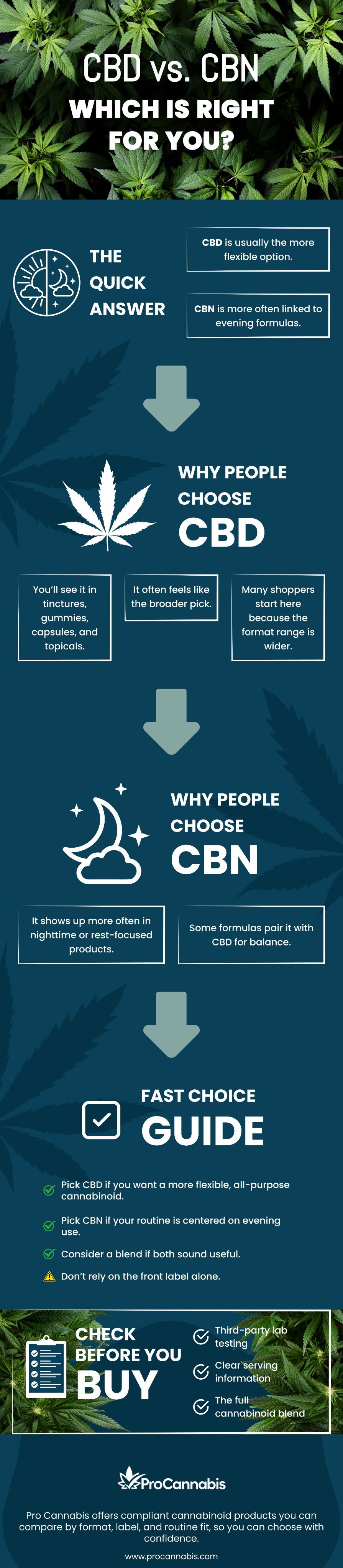
- CBD is the more flexible option, used throughout the day for general wellness, and available in nearly every product format.
- CBN is most associated with nighttime use and sleep support, typically formulated alongside other relaxing ingredients in evening-focused products.
- Typical dosing differs significantly: CBD doses range from 10-100mg per serving, while CBN servings are usually much smaller (2.5-25mg).
- Both can interact with medications — CBD especially, since it affects the same liver enzymes (CYP450) that metabolize many prescription drugs.
CBD and CBN often get grouped together on hemp product pages, but they serve genuinely different purposes. CBD has become the household cannabinoid name — recognized by most consumers, available in everything from tinctures to topicals to gummies. CBN is newer to most shoppers, almost always positioned around sleep and relaxation, and typically appears in smaller serving sizes. This guide breaks down how they actually differ in effects, dosing, format availability, and safety considerations — so you can match the right cannabinoid to what you're actually trying to accomplish.
How CBD and CBN Actually Differ
The most important distinction between CBD and CBN isn't about effects on the body — it's about how they're produced and what concentrations they're available in.
CBD (cannabidiol) is one of the most abundant cannabinoids in the hemp plant, present in high concentrations and easily extractable. Manufacturers can produce CBD in pure isolate form, in broad-spectrum extracts (containing many cannabinoids but no THC), or in full-spectrum products (containing trace amounts of THC). It's available at virtually any dose.
CBN (cannabinol) is naturally present in much smaller quantities. It forms over time as THC degrades through exposure to heat, light, and oxygen. Because of this natural scarcity, most commercial CBN is produced from THC through controlled conversion processes. CBN is typically available at lower potency per serving and at a higher price per milligram than CBD.
This sourcing difference affects how each cannabinoid is positioned and priced. CBD products lean toward "everyday wellness" framing because they're cost-effective at higher doses. CBN products lean toward "nighttime use" not just because of effect, but because the lower-volume servings make economic sense for occasional, evening-specific use.
What CBD Actually Does
CBD interacts with the body's endocannabinoid system primarily through indirect mechanisms — it doesn't bind directly to CB1 or CB2 receptors the way THC does. Instead, it influences how the body's own endocannabinoids signal, and it interacts with non-cannabinoid receptors (serotonin, vanilloid) that influence mood, pain perception, and inflammation.
Practically, this is what most users report:
- Mild relaxation without sedation — CBD typically produces a subtle calming effect rather than drowsiness, making it usable during work or social situations.
- Reduced perceived stress or anxiety — many users find CBD takes the "edge" off without dulling cognition.
- Anti-inflammatory effects — relevant for topical applications targeting localized soreness.
- Variable individual response — CBD's effects are subtle enough that some users notice clear benefits while others perceive little difference. Dose and consistency matter.
Onset varies by format: tinctures held under the tongue can take effect within 15-30 minutes, while edibles take 30-90 minutes. Effects typically last 4-6 hours.
What CBN Actually Does
CBN's reputation as the "sleep cannabinoid" is mostly anecdotal — clinical research on CBN as a sleep aid is limited and inconclusive. What's well-documented is that CBN binds to CB1 and CB2 receptors directly (unlike CBD), though with much weaker activity than THC. Some users report mild psychoactive effects at higher CBN doses, though this is far less common and less pronounced than with THC.
What users typically report:
- Mild sedative-like effects — heavier body sensation, slower mental tempo, lighter eyelids.
- Easier sleep onset — many users report falling asleep more easily, though improvements to sleep quality vary.
- Subtle effects compared to traditional sleep aids — CBN is not melatonin and not a sedative pharmaceutical. The effects are noticeable but not overwhelming.
- Synergistic in combination products — CBN's effects are amplified when paired with melatonin, magnesium, L-theanine, or other sleep-supporting ingredients.
Most CBN products on the market are not pure CBN — they combine CBN with CBD, melatonin, or other ingredients designed to compound the relaxation effect. The "CBN experience" most users report is usually the combined effect of the full formula, not CBN alone.

Realistic Dosing Guidance
Dosing varies significantly between the two cannabinoids:
| CBD | CBN | |
|---|---|---|
| Starting dose | 10-25mg | 2.5-5mg |
| Common adult dose | 25-50mg | 5-15mg |
| Higher-end dose | 50-100mg | 15-25mg |
| Onset (tincture) | 15-30 min | 15-30 min |
| Onset (edible) | 30-90 min | 30-90 min |
| Duration | 4-6 hours | 4-8 hours |
Both work best with consistency rather than single doses. CBD users typically report noticeable effects building over 1-2 weeks of consistent daily use, while CBN effects are usually more immediately apparent within the first few uses.
Drug Interactions and Safety
This is the section most CBD vs CBN guides skip, and it matters more than effect comparisons for many users.
CBD has documented interactions with several medication classes. CBD inhibits liver enzymes (CYP3A4 and CYP2C19 specifically) that metabolize a substantial portion of prescription drugs. This means CBD can effectively increase the blood concentration of other medications, sometimes meaningfully. Categories with known interactions include:
- Blood thinners (warfarin, others)
- Anti-seizure medications
- Some antidepressants and antianxiety medications
- Some statins and blood pressure medications
- Immunosuppressants
If you take prescription medications, consulting your doctor before starting CBD is genuinely important — this isn't just legal cover language. The interactions are real.
CBN has fewer documented interactions partly because it's been less studied. The same liver enzyme pathway applies in theory, but at typical CBN doses (5-25mg), the interaction potential is lower than CBD. Still, the same medical advice applies: consult before combining with prescription medications.
Both can affect drug test results. Full-spectrum CBD products contain trace THC (below 0.3% by dry weight) that can accumulate with regular use. CBN itself isn't typically detected by standard drug tests, but products marketed as CBN frequently include trace THC. If you're subject to drug testing, look specifically for "THC-free" or "broad-spectrum" formulations and verify with the COA.
Featured CBD and CBN Products at ProCannabis
A few products worth knowing about for each cannabinoid:
For CBD: Daily Wellness Use
Hometown Hero CBD — Hometown Hero's CBD lineup includes tinctures, gummies, and capsules. Their products work cannabinoids directly into formulations rather than spraying onto finished products, which produces more consistent dosing. Veteran-owned, third-party lab tested, with COAs publicly available on every product.
Sivan Remedies CBD — Sivan offers full-spectrum CBD products with strong third-party testing standards. Their tinctures and gummies are positioned around stress management and daily wellness.
Green Roads CBD — One of the longer-established CBD brands. Their pharmacist-formulated approach produces consistent products across categories — oils, gummies, topicals, and pet products.
For CBN: Evening and Sleep Support
Sivan CBD Sleep Gummies — Sivan's sleep formulation combines CBD with CBN and melatonin. The combined approach typically produces more noticeable sleep effects than CBN alone.
Wyld CBN Gummies — Wyld's sleep-focused gummies are well-formulated around CBN with supporting ingredients. Made with real fruit-derived flavors, which makes the experience more pleasant than many medicinal-tasting CBN products.
Browse All Sleep Aid Products — Our complete sleep-focused collection includes CBN-only, CBN+CBD, and CBN+melatonin formulations across multiple brands.
Which Is Right For You?
The honest framing is less about which cannabinoid is "better" and more about which fits your actual goal.
Pick CBD if you want:
- A cannabinoid you can use throughout the day without affecting alertness
- Flexibility across many product formats (tinctures, gummies, topicals, drinks, capsules)
- Lower per-mg cost for higher doses
- Established research and consumer track record
- General wellness support without specific time-of-day positioning
Pick CBN if you want:
- Evening-specific use focused on sleep onset
- A more sedative-leaning cannabinoid experience
- Combination products that pair CBN with other sleep ingredients
- Something you'll use occasionally rather than daily
Consider both if: You want CBD for daytime stress management AND CBN for nighttime sleep support. Many users genuinely benefit from both, used at different times for different purposes. Combined CBD+CBN products exist but aren't required — you can use them separately as needed.
Frequently Asked Questions
Is CBN stronger than CBD? +
Not really — they produce different effects, not stronger or weaker versions of the same effect. CBN binds to cannabinoid receptors more directly than CBD does, but at typical doses, both produce subtle effects rather than dramatic ones. The "strength" perception depends on what you're using it for.
Does CBN get you high? +
CBN is not considered psychoactive at typical doses. It interacts with the same receptors THC does but with much weaker activity. Some users report mild euphoria or perception changes at very high CBN doses, but these are far less pronounced than what THC produces and not the typical experience.
Can I take CBD and CBN together? +
Yes — they're commonly combined in commercial products, particularly sleep-focused formulations. The combination is generally well-tolerated. Many users find that CBD+CBN produces a more noticeable relaxation effect than either alone. Start with the lower end of typical doses for both when first combining them.
Will CBN make me fail a drug test? +
Pure CBN typically doesn't produce positive drug test results because most tests look for THC metabolites, not CBN. However, CBN products often contain trace amounts of THC (legally up to 0.3%) and CBN itself can occasionally cross-react with some tests. If drug testing is a concern, look for products specifically labeled "THC-free" and verify with the Certificate of Analysis.
How much CBN should I take for sleep? +
Most users find 5-15mg of CBN an effective evening dose, often taken 30-60 minutes before intended sleep time. Start at 2.5-5mg if you're new to CBN and increase from there. Combination products (CBN+melatonin or CBN+CBD) typically produce more consistent effects than CBN alone at the same dose.
Is CBD or CBN better for anxiety? +
CBD has stronger research backing for anxiety-related applications, while CBN is more associated with sleep. For daytime stress and anxiety, CBD is generally the more appropriate choice. CBN can help with sleep-related anxiety when used in the evening, but for general anxiety management, CBD is the more established option.
How long do CBD and CBN effects last? +
Both typically produce effects lasting 4-8 hours, depending on dose, format, and individual metabolism. Sublingual tinctures take effect within 15-30 minutes; edible forms (gummies, capsules) take 30-90 minutes. CBN's sleep-supporting effects often extend through the night, which is one reason it's positioned for evening use.
Are CBD and CBN federally legal? +
Both are federally legal under the 2018 Farm Bill when derived from hemp containing less than 0.3% Delta-9 THC by dry weight. The federal hemp definition is scheduled to change November 12, 2026 when Section 781 of H.R. 5371 takes effect, which may affect availability of full-spectrum CBD products specifically. CBD isolate and pure CBN products are generally expected to remain legal under the revised definition. State laws vary regardless of federal status.
Can I use CBD or CBN if I take prescription medications? +
Talk to your doctor first. CBD has documented interactions with several medication classes including blood thinners, anti-seizure medications, some antidepressants, statins, and immunosuppressants. CBN's interaction profile is less studied but follows similar metabolic pathways. The interactions aren't necessarily dangerous, but they can change how your medications work — your doctor can advise based on what you're taking.
What's the difference between CBN, CBD, and CBG? +
All three are non-intoxicating cannabinoids from hemp, but they're chemically distinct and produce different effects. CBD is widely associated with stress and general wellness. CBN is most associated with sleep. CBG (cannabigerol) is often called the "mother cannabinoid" because other cannabinoids derive from it; it's typically marketed for focus and clarity rather than relaxation. All three are commonly combined in formulations targeting specific outcomes.
Sources
- Harvard Health Publishing — Cannabidiol (CBD): What We Know and Don't
- Harvard Health — CBD and Other Medications: Proceed with Caution
- NCBI — Cannabinol (CBN) Research Overview
- Healthline — CBN vs CBD: What's the Difference?
- 2018 Farm Bill — H.R. 2
- H.R. 5371 — Section 781 (Federal hemp redefinition)
What It Comes Down To
CBD and CBN aren't really competitors — they're tools for different jobs. CBD has earned its broad market position because it works well for daily, all-purpose use across a wide range of formats. CBN has earned its narrower position because the evening-and-sleep framing genuinely matches how most users experience it.
If you're new to cannabinoid products, CBD is the easier starting point. Try it consistently for 1-2 weeks before deciding whether it works for you. If you're specifically looking for sleep support, CBN — or a CBN combination product — is the more targeted choice. And there's no rule saying you have to pick one; many users keep both in rotation for different times of day and different goals.
What matters more than the cannabinoid choice itself is product quality. Look for third-party lab testing, clear ingredient labels, and brands that share their Certificates of Analysis publicly. Those signals tell you more about whether a product will actually work than the cannabinoid type on the front of the package.
For more on cannabinoid effects, see our guides to how edibles work and choosing between sativa and indica. To browse current selections, see our complete CBD collection or sleep-focused products.