

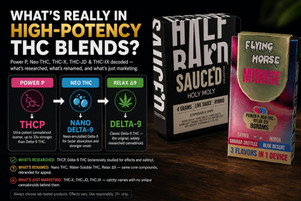
Pick up any high-potency disposable made in the last two years and read the box. Power P. Neo THC. THC-X. THC-JD. THC-IX. Somewhere between the flavor name and the gram count, the label turns into alphabet soup — and if you've ever searched one of those terms and found nothing useful, that's not your fault. Some of these names are real cannabinoids with published research behind them. Some are marketing names for compounds you already know. And some are names for things that, honestly, nobody outside the manufacturer can fully define. We sell these products, we read the lab reports, and this is the full decoder — what every term actually means, what's proven, what's claimed, and how to tell the difference in thirty seconds.
The Short Version:
- Every cannabinoid name on a blend label falls into one of three tiers: real compounds with research, marketing names for real compounds, and proprietary names with no published science behind them.
- Power P is THCP. Neo THC is nano-processed Delta-9. Relax Δ9 is Delta-9. Once you translate the marketing tier, most "exotic" labels get a lot less mysterious.
- THC-X isn't a molecule — it's a blend of Delta-8 esters, and the formula can differ between brands using the same name.
- A 2026 chemical analysis found that five commercial vapes labeled "THC-JD" contained no THC-JD at all. The name on the box and the contents of the tank are not the same thing.
- Which is exactly why the COA — not the cannabinoid name — is the only part of the label you should fully trust.
The three tiers of blend-label names
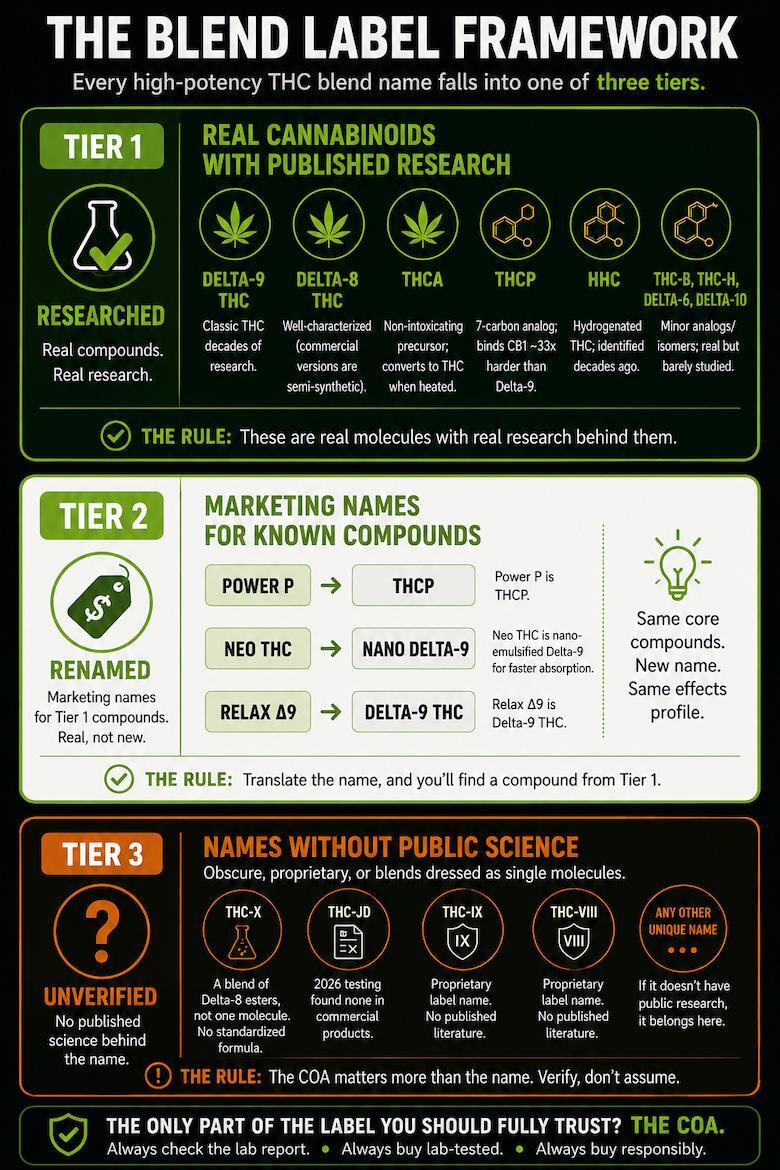
Here's the structure nobody in this industry writes down, because writing it down requires admitting how the labels work. Every term on a high-potency blend label is one of three things:
Tier 1: real cannabinoids with real research. Compounds that have been isolated, characterized, and published on. Delta-9, Delta-8, THCA, THCP, HHC. You can look these up in journals, not just on vendor blogs.
Tier 2: marketing names for Tier 1 compounds. Brands rename known cannabinoids for shelf appeal. Power P is THCP wearing a cape. Neo THC is Delta-9 that's been nano-processed. Nothing dishonest about it — but if you search the marketing name, you find nothing, and if you search the real name, you find the science. This decoder is the translation layer.
Tier 3: names without public science. Compounds that exist mostly as label copy — either genuinely obscure analogs with almost no research, blends dressed as single molecules, or proprietary names that don't appear in any journal. This is the tier where the honest answer is "the COA matters more than the name," and we'll be specific about which terms live here — including ones on products we stock.
Learn to sort a label into these tiers and you can decode any blend on the market, including next year's names that don't exist yet.
The decoder table
| Label term | What it actually is | Research status | Tier |
|---|---|---|---|
| Delta-9 THC | The classic THC molecule | Decades of research | 1 |
| Delta-8 THC | A milder Delta-9 isomer | Well-characterized; commercial versions semi-synthetic | 1 |
| THCA | Non-intoxicating precursor; converts to THC when heated | Well-established chemistry | 1 |
| THCP | 7-carbon THC analog; binds CB1 ~33x harder than Delta-9 | Peer-reviewed (2019) | 1 |
| HHC | Hydrogenated THC | Identified decades ago; modern research thin | 1 |
| Power P | THCP, renamed | See THCP | 2 |
| Neo THC | Nano-emulsified Delta-9 for faster absorption | Real processing method, not a new molecule | 2 |
| Relax Δ9 | Delta-9, renamed | See Delta-9 | 2 |
| THC-B | 4-carbon THC analog | Identified 2020; minimal research | 1 (early) |
| THC-H | 6-carbon THC analog | Identified 2020; minimal research | 1 (early) |
| THC-JD | Claimed 8-carbon analog | 2026 testing found none in commercial products | 3 |
| THC-X | A blend of Delta-8 esters, not one molecule | No standardized formula | 3 |
| THC-IX / THC-VIII | Proprietary label names | No published literature under these names | 3 |
| Delta-6 / Delta-10 | Minor THC isomers | Real; barely studied | 1 (early) |
Print that, or just remember the tiers. Now the details.
Tier 1: the compounds doing the actual work
Delta-9 THC needs no introduction — it's the anchor of nearly every blend, kept under 0.3% by dry weight for 2018 Farm Bill compliance. Delta-8 is its mellower cousin, real and well-characterized, though the versions in commercial products are made by converting hemp CBD rather than extracted directly. THCA is the quiet giant: non-intoxicating in the jar, full-strength THC the moment heat touches it, which is how THCA vapes and flower deliver a classic high while starting from legal hemp. Our THCA buyer's guide covers that conversion in detail.
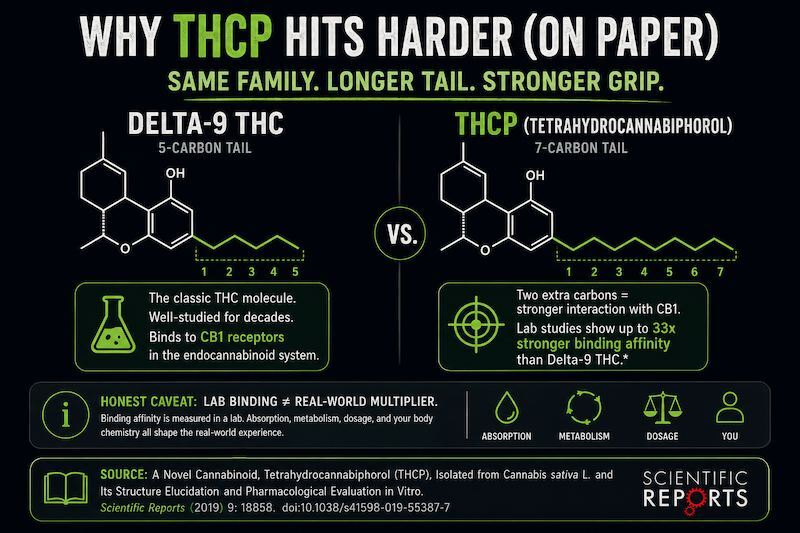
THCP is the one that changed the category. Research published in Scientific Reports in 2019 found it binds the CB1 receptor with roughly 33 times the affinity of Delta-9 in lab conditions — the strongest documented binding of any natural THC analog. Lab affinity isn't a potency multiplier in your body; absorption and metabolism still decide the experience. But the pattern we hear across the counter is consistent with the chemistry: THCP blends hit harder up front and last noticeably longer. It's why THCP anchors most of the strongest products we carry — see our full breakdowns of the strongest THC vapes and strongest THC gummies, and browse the THCP collection to see it in practice.
HHC rounds out the tier — a hydrogenated form of THC that's genuinely old news chemically (first made in the 1940s) with a smoother, slightly-below-Delta-9 effect profile, though modern human research is thin.
Tier 2: the translation layer
This tier is why the decoder exists. When Flying Horse prints Power P on the Mirage box, that's THCP — the same 33x-binding compound from the paper above, wearing the brand's name for it. Neo THC is Delta-9 that's been nano-emulsified: the particles are processed smaller so they absorb faster, which is a real technique borrowed from the beverage world, not a new cannabinoid. Faster onset is the honest claim; "new molecule" would not be. Relax Δ9 is Delta-9 with a mood attached.
None of this is deception — it's branding, and every industry does it. But it has a real cost to you as a buyer: search "what is Power P in a vape" and the internet shrugs, which leaves people either confused or overestimating how exotic their device is. The translation: the Mirage's Power P + Neo THC + Relax Δ9 stack is, in research terms, THCP + fast-absorbing Delta-9 + Delta-9. That's a genuinely strong, well-designed blend — it just sounds like three mystery compounds when it's really two known ones, engineered smartly. (For how the device itself works, our Mirage guide covers it end to end.)
Rule of thumb for this tier: if a name appears on exactly one brand's products, it's probably a rename. The chemistry lives under the boring name.
Tier 3: the frontier, honestly
Now the tier where we have to be more candid than most retailers are willing to be.
THC-B and THC-H sit at the edge of Tier 1 — they're real. The same Italian research team that identified THCP also characterized these butyl (4-carbon) and hexyl (6-carbon) THC analogs around 2020. Chain-length logic says they should bind CB1 differently than Delta-9, and that's plausible chemistry. But the potency numbers you'll see attached to them ("25 times stronger") have no published basis — they're extrapolation and anecdote. Real compounds, unproven claims.
THC-JD is the cautionary tale. It's marketed as an 8-carbon analog even stronger than THCP. Here's what testing found: a 2026 chemical analysis out of Portland State University ran five commercial vapes labeled as containing THC-JD through GC-MS analysis — and detected no THC-JD in any of them. Four of the five were mostly Delta-8. Whatever THC-JD is or isn't as a molecule, the products carrying its name were something else entirely. That's not an argument that every THC-JD product is mislabeled; it's proof that the name on a Tier 3 label guarantees nothing.
THC-X isn't a compound at all. It's a proprietary blend of Delta-8 esters — modified Delta-8 molecules designed for faster absorption — originally coined by one brand, now used loosely across the market with no standardized formula. Two products both labeled "THC-X" can contain different things. It'll still get you high, because the base is Delta-8. But you're buying a recipe, not a molecule, and the recipe varies by kitchen.
And THC-IX and THC-VIII — including on our own shelf. These names appear on high-end blends like Flying Horse's Black Edition, and here's the straight answer: they don't appear in the scientific literature. There's no published paper characterizing a "THC-IX." What that means in practice is that the names function as proprietary blend labels, and the only document that tells you what's actually in the device is the batch COA. We stock the Black Edition because its lab results are real and verifiable — the cannabinoid percentages, the contaminant screening, all of it — and because it delivers for the experienced users it's built for. But we won't pretend the name itself carries scientific weight, because it doesn't, and you deserve to know which part of the label is chemistry and which part is branding.
That last paragraph is the whole philosophy of this post: at the frontier, verification replaces vocabulary. The name tells you the marketing story; the COA tells you the contents.
The other half of the label: extract terms
The cannabinoid list is only half the code. The extract terms — live resin, liquid diamonds, live badder, live sugar, distillate — describe what was done to the plant, and they matter almost as much:
- Distillate is the refined baseline: pure cannabinoids, most of the plant's original terpenes stripped away.
- Live resin is extracted from flash-frozen fresh plant, preserving terpenes — fuller flavor, and many users report fuller effects at the same milligrams.
- Liquid diamonds blend THCA crystalline (the "diamonds" — among the most concentrated cannabinoid forms) back into terpene-rich sauce. Potency plus flavor.
- Live badder / live sugar are texture variants of the same terpene-preserving idea.
Two carts with identical cannabinoid percentages can feel meaningfully different because of this half of the label. When in doubt: live resin and diamonds over plain distillate at the high-potency end.
How to read any blend label in 30 seconds
- Find the Tier 1 anchors. Delta-9, Delta-8, THCA, THCP. That's the engine of the experience, whatever else is listed.
- Translate the marketing names. One-brand-only term? Assume it's a rename and find the compound underneath.
- Treat frontier names as a COA prompt, not a feature. THC-X, THC-JD, roman numerals — the moment you see one, the question isn't "how strong is this compound," it's "where's the lab report."
- Scan the QR code and read the COA. Cannabinoid percentages matching the label, plus screening for pesticides, heavy metals, and residual solvents. No COA, no purchase — the more exotic the label, the more this rule matters.
- Check the extract type — it's the difference between two "identical" carts.
Do that five-step scan and no label on the market can confuse you again.
Legal and workplace considerations
Everything discussed here is sold as hemp-derived under the 2018 Farm Bill's 0.3% Delta-9 threshold — but the ground is moving, and it's moving fastest under Tier 3. The November 2025 federal hemp law redefines what qualifies as hemp, and synthesized and converted cannabinoids — which describes most of the exotic tier, and commercial Delta-8 itself — face the tightest scrutiny as implementation rolls toward late 2026. Alternative cannabinoids remain on the market as of now, but the era of new mystery names may be closing on its own. State law varies on top of all of it; our cannabis laws by state guide stays current.
And the candor you'll always get from us: every intoxicating compound on this page — researched or not, renamed or not — produces THC metabolites your body accumulates, and any of these products can show up on a drug test. The obscurity of the cannabinoid does not confuse the test. You must be 21+ to purchase, and don't use these products if you're pregnant or nursing.
FAQ
Is Power P the same as THCP?
Yes. Power P is a brand name for THCP, the 7-carbon THC analog that research showed binds CB1 receptors roughly 33 times more strongly than Delta-9. Same compound, marketing name.
What is Neo THC?
Nano-emulsified Delta-9 THC — regular Delta-9 processed into smaller particles for faster absorption and quicker onset. It's a real technique, not a new cannabinoid.
Is THC-X a real cannabinoid?
Not as a single molecule. THC-X is a proprietary blend of Delta-8 esters with no standardized formula, so contents can vary between brands using the name. The effects come primarily from the Delta-8 base.
Is THC-JD legit?
The claimed compound may exist in trace amounts, but a 2026 university analysis of five commercial THC-JD vapes found no THC-JD in any of them — most were primarily Delta-8. Treat the name as unverified and judge products by their COA.
What are THC-IX and THC-VIII?
Proprietary label names with no published scientific literature behind them. They appear on high-potency blends, and the honest way to evaluate those products is the batch COA, which shows the actual verified contents.
Which cannabinoid is actually the strongest?
Among researched compounds, THCP has the strongest documented receptor binding — roughly 33 times Delta-9's affinity in lab studies. Claims that frontier compounds beat it have no published support. In practice, blend design, extract quality, and your own tolerance shape the experience as much as any single molecule.
Will exotic cannabinoids show up on a drug test?
Yes. THC analogs and derivatives metabolize into the same family of compounds standard tests screen for. No cannabinoid on this page is a drug-test workaround.
The strongest expression of the researched tier is what we actually recommend: browse the THCP collection, see how the compounds stack up in real products in our strongest THC vapes and strongest THC gummies breakdowns, and whatever you buy — from us or anyone — scan the COA first. The name is the story; the lab report is the truth.